
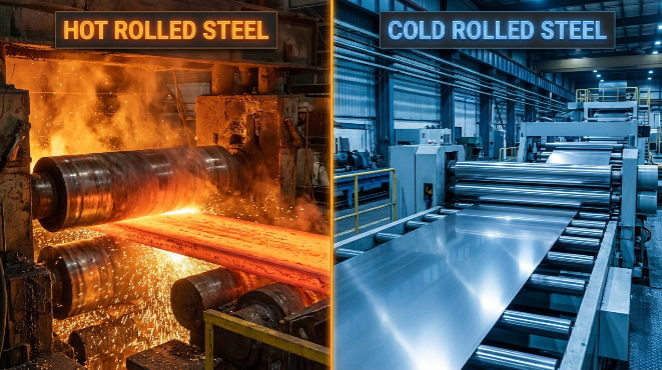
Choosing between Hot Rolled (HRC) and Cold Rolled (CRC) steel is one of the most common decisions procurement managers face. While both start from the same raw material, the processing makes them distinct products with different applications, prices, and strengths.
At Arham Steel Industries, we stock both, and understanding the difference can help you save costs and improve project quality.
What is Hot Rolled Coil (HRC)?
Hot rolling involves processing steel at high temperatures (typically over $1,700^\circ \text{F}$), which is above the steel’s recrystallization temperature. This makes the steel easier to shape and form.
- Best For: Structural components, I-beams, construction tracks, and agricultural equipment where precise shapes and tolerances are less critical.
- Arham Specifications: We supply HRC Coils with a thickness range of $0.70 \text{ mm}$ to $4.0 \text{ mm}$2.
What is Cold Rolled Coil (CRC)?
Cold rolled steel is essentially hot rolled steel that has been through further processing. It is cooled and then rolled at room temperature to achieve exact dimensions and better surface qualities.
- Best For: Precision applications, home appliances, metal furniture, and projects requiring a smooth, aesthetic finish.
- Arham Specifications: We supply CRC Coils with a thickness range of $0.50 \text{ mm}$ to $1.2 \text{ mm}$3.
Quick Comparison Table
| Feature | Hot Rolled (HRC) | Cold Rolled (CRC) |
| Processing | High Heat | Room Temperature |
| Surface Finish | Rough, Scaly | Smooth, Oily |
| Tolerance | Less Precise | Very Precise |
| Arham Thickness | Up to $4.0 \text{ mm}$ | Up to $1.2 \text{ mm}$ |
The Verdict
If your project structure is hidden or requires heavy thickness, HRC is the economical choice. If you need precision, a smooth finish for painting, or thinner gauges, CRC is the superior option.